Spending, Saving & Your Income
If you've already built out your budget, you probably have a solid perspective on your income. Pair that with the way you save and spend your money, and you have a good idea whether you need to change some habits.
See the tabs below for more information on finding the right balance for between your income and how you spend the money once you have it.
Income is just like every other area of your finances; it's important to talk about your incomes together--no matter how low or high they may be--and then plan based on them. You need to make sure that you have enough money to support one another. See the Standard of Living Chart below for how your level of income matched with your current expense habits will generally effect your lifestyle.
What's Our Standard of Living?
| Living above your means | Living at your means | Living within/under your means | |
|---|---|---|---|
| Definition | You make less than you spend. | You make just enough to meet your expenses. | You make more than you spend. |
| Results | You are/will be in debt. This arrangement is always stressful for a marriage. | You're staying out of debt as long as nothing unexpected happens, but you are not able to save up for the future. | You are able to meet your expenses easily. You have money to set aside for retirement and future expenses. |
| Considerations | Find a way to cut down expenses and pay off debt. Possibly even postpone the wedding until you can pay down current debt & work into a better situation. | There may be expenses that you don't need. Look for ways to cut costs so you can start setting aside, even if just a little at a time. | The ideal situation. Still, circumstances can change. You have financial flexibility now, but don't be irresponsible & stop planing for the future. You may even consider whether you can add investments with a higher risk in your budget. |
Should We Have Single or Dual Incomes?
 You may feel that having two incomes may be a great way to build a stronger financial foundation--more money for savings, more for retirement, extra spending money at the end of the month. Or on the flip side, you feel your current needs & future savings warrants only a single income. Neither is right or wrong for every couple.
First, for some people, cutting back to a single income isn't plausible. Regardless of whether they want to live off of one income, they couldn't meet expenses that way. The responsibility of staying out of debt necessitates two incomes. If you're in this category, try cutting expenses if you want to open up the single income option.
If you can live out of debt with only one income, ask yourselves what you want to accomplish with a second income. It may be that both of you working isn't even about the income. Either way, it's a good practice to budget for each scenario, seeing what your give and take will be. Here are some considerations of costs you may need to factor in:
Dual Income:
- Higher food budget for eating out or buying prepared food.
- Maid service
- Lawn care
- Child care
Single income:
- Higher utilities from being home more
- Higher activity/outing expenses, especially when kids are involved
Consider as well whether a second income would move you to a higher tax bracket. Does the added income from the second job offset the jump to a higher bracket enough to make it worth the time and effort being invested to gain the second income.
Even more important than the question of income itself is how you plan to spend and/or save the money you receive. Look at and talk through one another's current spending habits to see where and how each of you prefers to direct your money. As part of your budgeting process, you'll then want to decide how you intend to spend and save your money moving forward. Consider some of these questions in your discussion:
Do we need a savings account?
 In short, yes. You need a way to save money apart from your checking account so you can still access it when you need. Maybe it's not specifically a savings account. It could be a money market account or even another checking account. Remember that savings and money marketing accounts and even some checking accounts earn interest on your balance, too. Without a method of savings in place, though, you run the risk of not being prepared for unexpected expenses--and there are a lot of them.
How much should we have saved up?
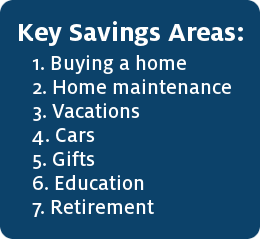 And what should we save for, too?
A common recommendation from financial experts is to save the equivalent of nine months' to one year's income. This savings provides you with a healthy cushion in case of something like sickness, injury or loss of a job should keep you from earning for a longer period of time.
How many savings accounts should we have? Should they be at one bank?
When you're saving for these key areas like a home, vacation or even retirement, you may like to see a clear division between the funds. It's all right to have multiple savings accounts, and it's all right to have them at separate banks. How many is up to you and your needs. Keep in mind, though, that with every account you have, you further divide your assets and continue to lower your opportunity for a higher return on your balance. (Most traditional savings accounts earn interest at higher rates when the balance reaches a higher tier.) With more accounts and separate institutions, you also open yourself up to more fees and more time tracking your account.
Still, having multiple accounts in different locations gives you an additional safety net should one of your accounts be compromised and you need to access money in a hurry. This can also act as a barrier to keep you from quickly transferring money from savings to checking to cover that impulse buy.
How important is it to review your (and your parents') spending habits?
Far more important than you may realize. What a person grew up around and witnesed for his or her entire life will very much influence that person's spending habits now. The habits that a person has now are also ingrained as a part of that person you are committing yourself to. Even working together, replacing those habits and mindsets may take a lot of time, but until you review the habits, they will likely stay unchanged.
Will you help friends or family in need of money?
Inevitably, someone that one or both of you care about will at some point in your marriage mention that he or she is struggling financially and may even ask you directly for money. Decide before you ever get to that point what your "house rules" will be.
While helping others can bring you joy and delight under the right circumstances, you have a responsibility to take care of your immediate family before any friends who come calling. If you're living above your means, you already have the responsibility of helping someone in need of money: yourself . Adding to your debt by giving money to others does little to help you or your marriage. If you feel obligated to help, consider whether your friends or family need something beyond an immediate handout like help finding a job.
If you decide to help, make sure you know and are on the same page between yourselves as well as with the borrower about the expectations of repayment. If you're worried about repayment, you could even give it as a gift. That way, if you're not paid back, the relationships involved are not hurt. Be cautious, too, that you're not frivolous in your giving just because you have a little extra. Stay aware of your needs and made sure you are covering your expenses.
How to Start the Conversation
If you're not used to talking about money with another person, don't worry. No one starts out a pro. For thoughts around getting the converation going, see our page on talking about money